Wildfire smoke can raise particle levels far from the flames and change quickly with wind and atmospheric mixing. Check PM2.5 or the local air-quality index instead of relying on smell or visibility, then follow health and emergency guidance for your area.
What Is Wildfire Smoke?
Wildfire smoke is a changing mixture of fine particles, gases and water vapour released as vegetation and other material burns. What it contains depends on the fuel, the temperature of the fire and how completely it burns. Smoke from a forest fire can therefore differ from smoke produced when a fire reaches buildings, vehicles or other manufactured materials.
For most people away from the flames, PM2.5 is the main health concern. These particles are no more than 2.5 micrometres across, small enough to travel deep into the lungs. Smoke also contains larger particles and gases such as carbon monoxide and volatile organic compounds. Close to an active fire, heat, flames, ash and toxic gases create immediate dangers that an air-quality reading cannot describe.
If authorities issue an evacuation order or other emergency instruction, follow it. The guidance below is for reducing smoke exposure when you are not in the fire zone.
Why Smoke Can Arrive From Far Away
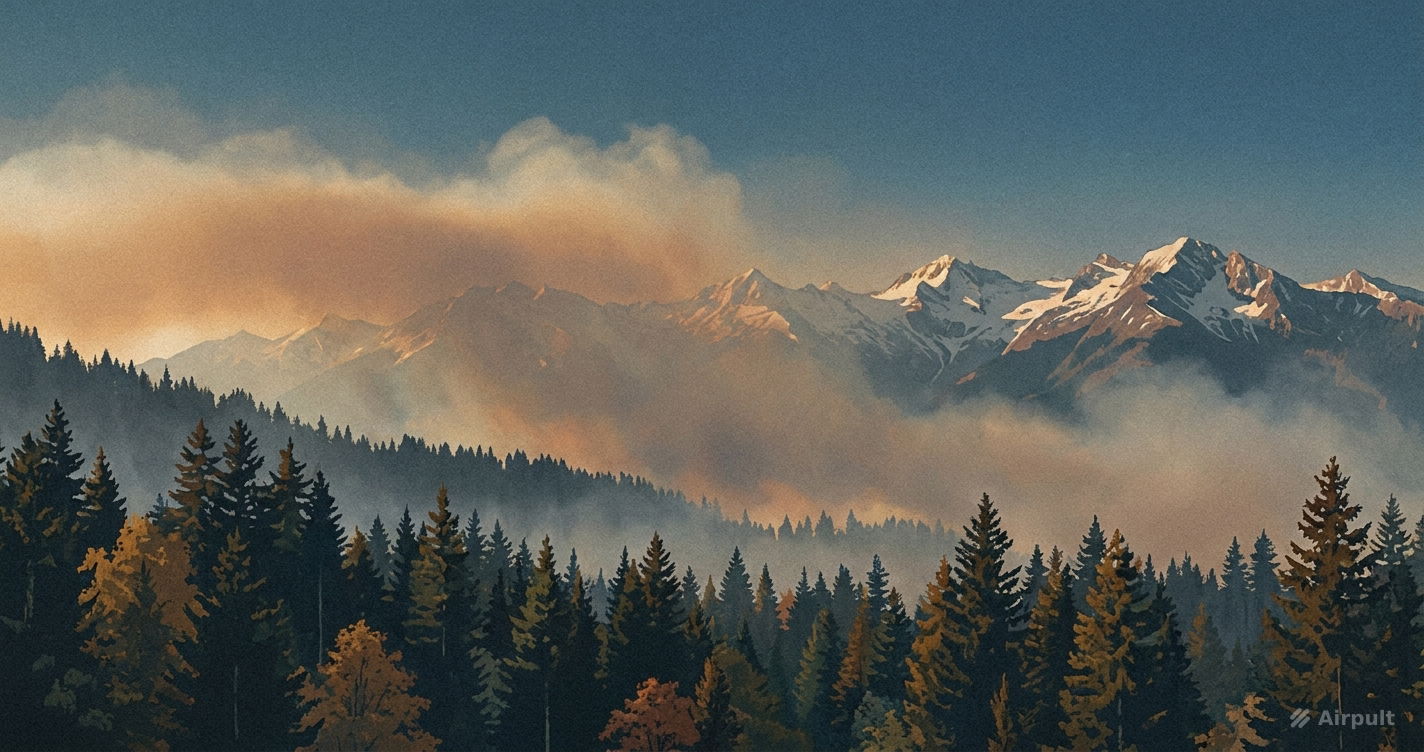
Hot air above a fire rises and carries smoke with it. Large, intense fires can lift a plume several kilometres into the atmosphere, where stronger winds may transport it across countries or oceans. Smoke nearer the surface follows lower-level winds and is more likely to affect the air people breathe.
A dramatic plume overhead does not always mean poor air quality at ground level. Some smoke remains aloft. The reverse is also possible: a thin or nearly invisible layer near the ground can raise particle concentrations enough to matter. Haze and a red or orange sunset are clues, but they cannot replace a local PM2.5 measurement.
Terrain and atmospheric stability shape the impact. Valleys can collect smoke, while a temperature inversion can trap polluted air close to the surface. A wind shift may clear one area and worsen conditions a short distance away. This is why smoke exposure can change quickly even when the fire itself is far away.
What PM2.5 and AQI Tell You
PM2.5 is measured as a concentration, usually in micrograms per cubic metre of air. The Air Quality Index, or AQI, translates pollutant concentrations into a simpler health scale. During a wildfire smoke episode, fine particles often determine the overall AQI.
AQI systems and category boundaries differ between countries. Use the health advice attached to the local index rather than assuming that a colour or number means the same thing everywhere. Our AQI guide explains what the index measures and why the dominant pollutant matters.
Check the current reading as well as the forecast. A daily average can hide a sharp change caused by a passing plume, an inversion or a shift in wind direction. Nearby sensors may also disagree because smoke is patchy and low-cost instruments can respond differently to humidity and particle composition. Look for the trend across several readings instead of treating one number as exact.
How Wildfire Smoke Affects Health
Smoke can irritate the eyes, nose and throat and cause coughing, wheezing, headache or shortness of breath. Fine particles can worsen asthma and other lung conditions. They are also linked with effects on the heart and circulation.
Some people are more likely to become unwell or develop more serious symptoms, including:
- Children and older adults
- Pregnant people
- People with asthma, COPD, heart disease or other chronic conditions
- People who work, exercise or spend long periods outdoors
- Anyone with limited access to a cleaner indoor space
Reducing exposure is useful for everyone when smoke levels rise. People at higher risk should follow their clinician’s advice and keep prescribed medication accessible. Seek urgent medical help for severe trouble breathing, chest pain, confusion, fainting or other emergency symptoms. Local health services can advise on symptoms that are new, worsening or difficult to control.
How to Reduce Smoke Indoors
Indoor air is usually less smoky than outdoor air when a building is closed, but particles still enter through ventilation, gaps and opened doors. A cleaner room gives you one space where you can keep that infiltration as low as possible.
Choose a room where you spend plenty of time and where windows and doors close properly. Then:
- Close windows and external doors while outdoor air quality is poor.
- Use a portable air cleaner sized for the room, preferably with a mechanical high-efficiency or HEPA filter.
- Run the cleaner continuously and check the filter more often during a prolonged smoke episode.
- Set compatible heating, ventilation or air-conditioning systems to recirculate, and use the highest-efficiency filter the system can safely support.
- Avoid producing extra particles by smoking, burning candles or incense, using a wood fire, frying at high heat or vacuuming without suitable filtration.
Do not use an ozone generator to remove smoke. Ozone irritates the lungs, and devices that intentionally produce it are not a safe substitute for particle filtration.
Closing a home can increase indoor heat during hot weather. If the room becomes dangerously warm, move to a cooler place with filtered air, such as an official clean-air shelter or another air-conditioned public building. Balance smoke protection with heat safety and follow local advice.
A cleaner room helps only while authorities say it is safe to remain in the building. Keep exits usable, be ready to leave and follow an evacuation order immediately.
Power outages can add a carbon monoxide risk. Never run a portable generator, charcoal grill, camp stove or other fuel-burning device indoors or near doors, windows or vents. Use a working carbon monoxide alarm. Particle filters and particle sensors do not remove or detect carbon monoxide.
Choosing an Air Cleaner
Filter type matters, but airflow matters too. A small cleaner with an excellent filter may not process enough air for a large room. Check the recommended room size or clean air delivery rate, and place the unit where air can move freely around it.
Mechanical filters capture particles; they do not remove every gas in smoke. Activated carbon may reduce some gases and odours, but performance varies with the amount of carbon and the chemicals present. Smell is therefore a poor measure of particle exposure. Air may smell smoky even when a particle filter is working, or contain high particle levels without a strong smell.
A correctly built fan-and-filter unit can lower indoor particle levels when a commercial cleaner is unavailable. Follow current fire-safety instructions from your local public-health or fire authority, use compatible equipment and never leave a homemade unit running unattended.
Do Masks Protect Against Smoke?
A well-fitting particle respirator such as an N95, FFP2 or equivalent certified model can reduce the amount of smoke particles you inhale. It must seal closely around the nose, cheeks and chin. Facial hair, gaps or the wrong size reduce protection.
Loose surgical masks, cloth masks and neck gaiters do not provide reliable protection from fine smoke particles because unfiltered air passes around their edges. Certified particle respirators also do not protect against carbon monoxide or many other gases. They are not a substitute for evacuation, cleaner indoor air or professional respiratory equipment near a fire.
People with a heart or lung condition should seek medical advice if wearing a respirator makes breathing difficult. Children need a model that fits correctly; adult-sized respirators often do not seal on a child’s face.
Outdoor Activity During a Smoke Episode
The dose you receive depends on concentration, time and breathing rate. Running, cycling and strenuous work make you breathe more air, so the same PM2.5 level produces a larger inhaled dose.
When local guidance recommends limiting exposure:
- Move exercise indoors or postpone it.
- Keep necessary trips short.
- Choose a cleaner time or place if conditions vary through the day.
- Wear a well-fitting certified respirator if you must spend time outside.
- Take extra care on smoky and hot days, when smoke exposure and heat stress can occur together.
Visibility can deteriorate when a dense plume reaches the surface, but visibility and particle concentration do not have a fixed relationship. Read how haze affects visibility, and use air-quality data for health decisions.
Smoke, Ash and Odour Are Different
Smoke particles remain suspended in the air. Ash is larger material that settles on cars, windows and the ground. Disturbing dry ash can put particles back into the air, and ash from burned structures may contain hazardous material. Follow local cleanup instructions, keep children and pets away, avoid dry sweeping and use the protective equipment recommended for the site.
Odour comes mainly from gases. Your nose can detect some smoke compounds at very low levels, so smell does not tell you how much PM2.5 is present. It should prompt you to check conditions, not serve as your only monitor.
Reading a Wildfire Smoke Forecast
Smoke forecasts combine detected fires, estimates of emissions, weather forecasts and models of atmospheric transport. They can show where a plume may travel and whether smoke is expected near the surface or higher in the atmosphere.
Uncertainty grows when fire behaviour or wind changes. Rain may remove some particles, while stable air can hold smoke near the ground. Compare the forecast with current observations and official warnings, then check again before making outdoor plans.
How Airpult Represents Air Quality
Airpult's air-quality pages use modelled pollutant concentrations from CAMS, not a monitor at your location. Airpult calculates a U.S. AQI from the available PM2.5, PM10, ozone, nitrogen dioxide, sulfur dioxide and carbon monoxide estimates, then uses the highest pollutant sub-index. The displayed current value comes from the model hour nearest the current time.
For PM2.5, Airpult currently converts the modelled concentration with the U.S. EPA breakpoints that preceded the agency’s 2024 update. Where the EPA revised those thresholds, Airpult’s PM2.5 sub-index can therefore be lower than one calculated with the current EPA method. Our guide to PM2.5 and PM10 explains the difference between particle concentration and AQI.
This is a general air-quality estimate, not a smoke-specific index, and Airpult does not identify the pollution source. Use Airpult Explore and the air-quality page for broad context. During a smoke episode, compare them with official local monitoring, smoke information, health advice and emergency instructions because a model grid may miss a recent or highly localised plume.