A solar eclipse can change daylight dramatically, but what you see depends on your position under the Moon’s shadow. Check the local circumstances before travelling, and use proper solar protection through every partial or annular phase.
What Is a Solar Eclipse?
A solar eclipse happens when the Moon passes between the Sun and Earth, blocking some or all of the Sun and casting a shadow across part of our planet. It can only happen at new moon, when the Moon is on the daytime side of Earth.
The Sun is about 400 times wider than the Moon, but it is also about 400 times farther away. That coincidence makes the two discs appear almost the same size in our sky. When their apparent sizes and positions line up closely enough, the Moon can cover the Sun.
An eclipse is not visible from the whole world at once. The Moon’s shadow crosses a limited part of Earth, so the type of eclipse you see depends on where you are in relation to that shadow.
How a Solar Eclipse Happens
Sunlight passing around the Moon creates several parts of a shadow:
- Umbra: The dark central shadow where the Moon completely covers the Sun. An observer inside it sees a total solar eclipse.
- Penumbra: The wider, lighter shadow where the Moon covers only part of the Sun. An observer here sees a partial eclipse.
- Antumbra: The shadow beyond the tip of the umbra. From here, the Moon appears too small to cover the whole Sun, producing an annular eclipse.
These shadows move across Earth as the Moon travels in its orbit and Earth rotates. The umbra or antumbra traces a narrow central path, while the penumbra can cover a much broader region on either side.
Why There Is Not a Solar Eclipse Every New Moon
The Moon’s phases repeat roughly every 29.5 days, but its orbit is tilted by about 5 degrees relative to Earth’s orbit around the Sun. At most new moons, the Moon passes slightly above or below the Sun from our point of view, and its shadow misses Earth.
An eclipse becomes possible when a new moon occurs near one of the two points where the Moon’s orbit crosses Earth’s orbital plane. These opportunities come in eclipse seasons, which occur about twice a year. Each season lasts a little over a month and can contain more than one solar or lunar eclipse.
The Four Types of Solar Eclipse
The Earth-Moon and Earth-Sun distances vary as the Moon and Earth travel in their orbits, so both discs change slightly in apparent size. Those apparent sizes, together with the alignment and the observer’s location, determine which type of solar eclipse occurs.
Total Solar Eclipse
A total solar eclipse happens when the Moon appears large enough to cover the Sun’s bright face completely. Totality is visible only from inside the Moon’s umbra, along a narrow track called the path of totality.
Outside that path, observers see a partial eclipse. Even a location close to the edge may miss totality entirely, so a small change in position can produce a very different view.
Annular Solar Eclipse
An annular solar eclipse occurs when the Moon passes directly in front of the Sun while it is farther from Earth and appears slightly smaller. A bright ring of sunlight remains around the Moon, often called the ring of fire.
Annularity is not the same as totality. The Sun’s bright surface is never fully covered, so solar viewing protection must remain in place throughout the eclipse.
Partial Solar Eclipse
A partial solar eclipse is seen where only the Moon’s penumbra reaches Earth. The Moon appears to take a curved bite out of the Sun, with the covered fraction changing as the eclipse progresses.
People outside the central path of a total or annular eclipse also see a partial eclipse. There is no safe unfiltered phase, even when only a thin crescent of the Sun remains.
Hybrid Solar Eclipse
A hybrid solar eclipse changes between total and annular along different sections of its path. Earth’s curved surface changes the distance between observers and the Moon just enough for the Moon to appear slightly larger than the Sun in some places and slightly smaller in others.
Hybrid eclipses are uncommon, and most people within their wider viewing region still see only a partial eclipse.
What Happens During Totality?
The partial phases build gradually as the Moon moves across the Sun. Inside the path of totality, the last points of direct sunlight can break through valleys along the Moon’s edge, forming bright spots known as Baily’s beads. The final bright point creates the diamond ring effect.
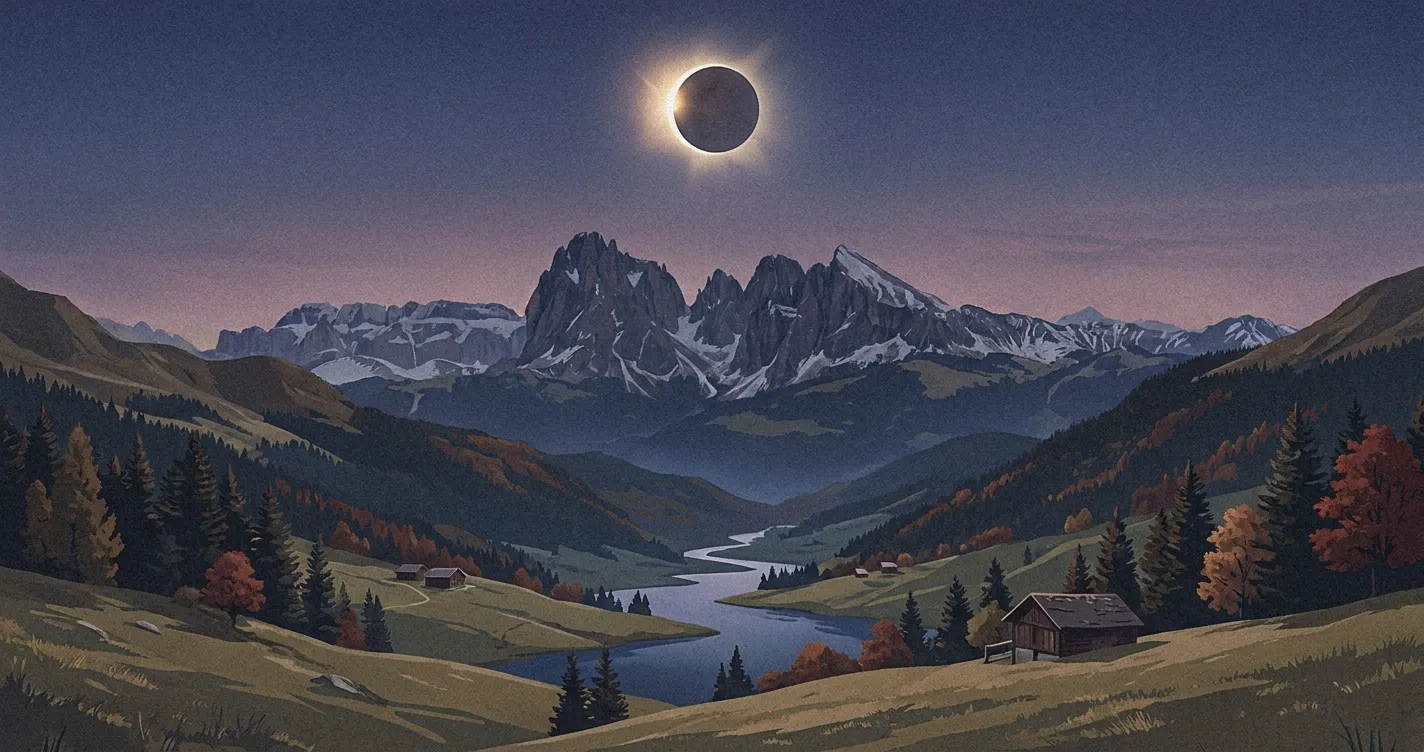
Once the Sun’s face is fully covered, its faint outer atmosphere becomes visible as a pale corona around the Moon. The sky darkens, bright planets and stars may appear, and the horizon can take on the colours of sunset in every direction. Daytime temperatures often fall, while birds and other animals may respond as though night is arriving.
Totality usually lasts only a few minutes. As soon as the first point of the Sun returns, direct viewing protection must go back on.
How to View a Solar Eclipse Safely
Looking directly at the Sun can injure your eyes without causing immediate pain. Except during the brief period of complete totality, use special-purpose eclipse glasses or a handheld solar viewer from a supplier vetted by a recognised astronomy organisation. The viewer must comply with the transmittance requirements of the ISO 12312-2 international standard for direct solar viewing. A printed ISO logo or claim alone does not prove that a product has been tested.
Follow these rules throughout the event:
- Ordinary sunglasses are not safe, no matter how dark they are.
- Put the eclipse glasses or viewer over your eyes before looking towards the Sun. Turn away before removing them.
- Inspect eclipse glasses before use and discard them if the lenses are scratched, torn, punctured, or loose.
- Supervise children and make sure the viewer stays in place before they look towards the Sun.
- Never look through a camera, binoculars, or a telescope while wearing eclipse glasses. Concentrated sunlight can burn through the viewer and damage your eyes.
- ISO 12312-2 does not apply to filters for cameras, binoculars, or telescopes. Seek expert advice and use a solar filter designed for the device, fitted securely over the front aperture where sunlight enters.
- During a partial or annular eclipse, keep protection on for the entire event.
You can also watch indirectly with a pinhole projector. Stand with your back to the Sun and let light pass through a small opening onto a card or the ground. The projected image will show the Sun changing shape without anyone looking at it directly.
How Weather Affects Eclipse Viewing
An eclipse follows a precisely calculated path, but the view still depends on the weather. Thick low cloud can hide the Sun completely, while broken cloud may reveal it for only a few moments. Thin high cloud often leaves the Sun visible but softens the corona and reduces contrast during totality.
Check the cloud cover forecast for the hours around the eclipse, not only the daily weather symbol. Visibility, humidity, and the chance of fog also matter, especially for eclipses close to sunrise or sunset. The visibility resource explains how haze, mist, and particles can affect how far and how clearly you can see.
If you can travel, compare several locations along the eclipse path rather than relying on one forecast. Weather confidence usually improves closer to the event, so keep more than one viewing site available until the final day.
Photographing a Solar Eclipse
A camera needs protection from direct sunlight too. Use a proper front-mounted solar filter through every partial phase. During a total eclipse, the filter may be removed only while the Sun’s bright face is completely covered, then replaced before direct sunlight returns. For partial and annular eclipses, it stays on throughout.
Practise with the filtered Sun before eclipse day. Learn how to focus manually, test several exposures, and make sure the filter cannot slip. A tripod and delayed shutter can reduce movement, while exposure bracketing helps with the large change in brightness between the partial phases and the corona.
A long lens can record the changing solar disc, but the eclipse is also visible across the landscape. Wide photographs can include the darkened sky, people watching, sharp crescent-shaped shadows, and the colours near the horizon. Plan the technical steps in advance so you are not changing settings through the briefest part of the event.
Finding the Next Solar Eclipse
Eclipses can be calculated far in advance because the motions of the Sun, Earth, and Moon are well understood. The Airpult eclipse calendar lists the solar and lunar eclipses in the current calendar year. The dynamic card below looks in the current and following year to show the next solar eclipse.
The calendar and card show the global event date and type, not local contact times, duration, magnitude, covered fraction, or path boundaries. Those circumstances are specific to each location. Check a specialised eclipse map or local astronomy authority before making travel plans, even if your country appears on a global visibility map.
How Airpult Helps You Plan Eclipse Viewing
Use the dynamic card for the next solar event and the current-year eclipse calendar for that year’s list. Airpult does not calculate eclipse visibility, path boundaries, or local contact times. Get those details from a specialised eclipse map or local astronomy authority.
As the event approaches, use Explore to choose candidate locations and open their general forecasts. Our forecast shows current conditions, an hourly temperature curve and precipitation chances, and daily highs and lows. It does not provide an eclipse-specific visibility forecast or a confidence estimate for cloud cover. For a low eclipse, compare local contact times with sunrise or sunset for the same place and date.