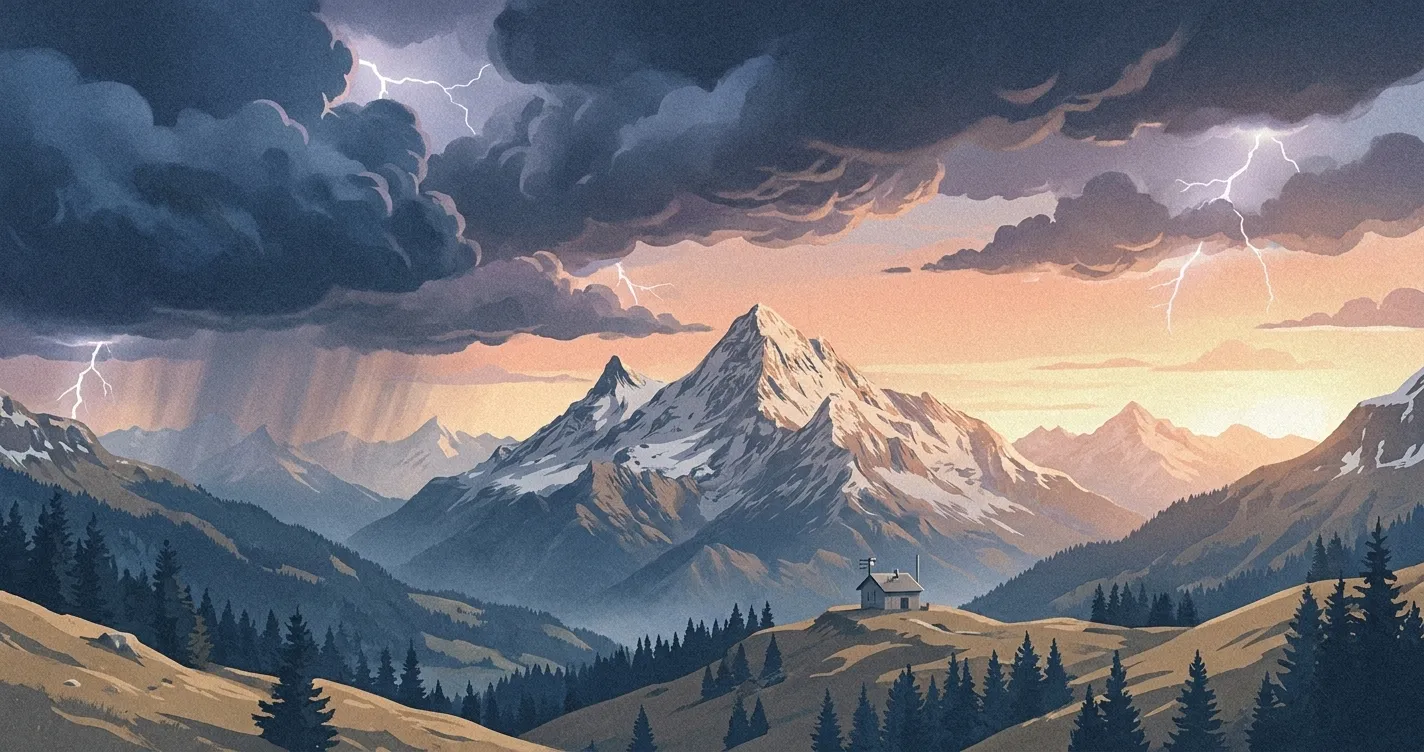
Thunder means lightning is already close enough to strike. This guide explains how thunderstorms, lightning, hail and downbursts form, what a forecast can resolve, and where to shelter.
What makes a thunderstorm?
A thunderstorm is a convective storm that produces lightning and therefore thunder. Heavy rain alone does not make a shower a thunderstorm. Some thunderstorms pass in less than an hour, while organised systems can continue for many hours and affect a large area.
Every thunderstorm can produce dangerous lightning. Stronger storms may also bring torrential
[precipitation](/resources/precipitation), damaging
[winds](/resources/wind-speed), hail, flash flooding or tornadoes. A storm does not need to be classified as severe for its lightning to be dangerous.
The three ingredients
Thunderstorms usually need moisture, instability and a source of lift.
- Moisture supplies the water vapour from which cloud droplets, rain and ice form.
- Instability allows a rising parcel of air to remain warmer and less dense than its surroundings, so it keeps rising.
- Lift starts that upward motion. Heating at the ground, fronts, converging winds and hills or mountains can all provide it.
Convective Available Potential Energy, or CAPE, describes how much buoyant energy a rising parcel could have. CAPE is useful, but it is not a storm forecast by itself. Wind shear, moisture depth, a cap of warm air aloft and the strength of the lifting mechanism all affect whether storms form and how they organise.
How a thunderstorm develops
The familiar three-stage life cycle describes a simple, short-lived cell. Organised thunderstorms are more complicated because they can continually develop new cells or keep their updraft and downdraft apart.
Developing stage
Warm, moist air rises and cools. Water vapour condenses, releasing heat that helps the updraft continue. The cloud grows from cumulus into towering cumulus. During this stage, the cell is dominated by rising air and little precipitation reaches the ground.
Mature stage
Once rain and ice particles become heavy enough to fall, they drag air downward and create a downdraft. The storm now contains both rising and sinking air. This is usually its most active stage, with heavy rain, lightning, gusty winds and sometimes hail.
The cloud may reach the tropopause, where the stable air above slows its vertical growth. Strong winds near that level spread cloud ice downwind into the familiar anvil. Lightning can extend from the cloud or anvil beyond the area of heavy rain.
Dissipating stage
In a simple cell, cool outflow eventually cuts off the supply of warm, moist air. The updraft weakens, rainfall eases and the cloud begins to decay. Lightning can continue during this stage, so fading rain is not an all-clear signal.
Cumulonimbus clouds
The cloud associated with a thunderstorm is the cumulonimbus. It often has a dark base, a tall cauliflower-shaped tower and, when fully developed, an anvil top. Its height and cloud base vary greatly with the season, climate and amount of moisture near the ground.
Pouch-like mammatus clouds can hang below an anvil. They show that the air around the anvil has a complex mix of sinking and rising motion, but they do not prove that a tornado is forming. Visual clues can help you recognise a storm, but radar and official warnings are more reliable guides to its hazards.
How lightning forms
Inside a deep thunderstorm, ice crystals, graupel and supercooled water collide in strong, turbulent currents. Under common storm conditions, these collisions help separate electrical charge. Lighter ice crystals tend to be carried higher while heavier graupel remains lower, creating regions with different charges.
Scientists are still studying the details of storm electrification. The broad result is clear: when the electric field becomes strong enough to break down the insulating air, a lightning channel develops. Most lightning occurs within a cloud or between clouds. Cloud-to-ground flashes account for a smaller share, but they pose the most direct risk to people and structures.
A cloud-to-ground flash develops through branching channels called leaders and upward streamers from the ground or objects on it. Once they connect, a bright return stroke travels through the channel. Several strokes may use the same channel in quick succession, which makes the lightning appear to flicker.
Why thunder arrives later
Lightning heats the narrow channel of air extremely quickly. The air expands and produces a shock wave that becomes thunder. Light reaches you almost instantly, while sound moves much more slowly.
You can estimate the distance by counting the seconds between the flash and thunder. Divide by three for an approximate distance in kilometres, or by five for miles. This estimate is useful for understanding what you saw, but it is not a safety threshold. If you hear thunder, lightning is already close enough to strike.
So-called heat lightning is ordinary distant lightning. You see the flash, but the thunder is too far away or too faint to hear.
Common thunderstorm structures
Meteorologists describe storms by how their updrafts and cells are organised.
- Single-cell storms are short-lived and usually weaken when their downdraft cuts off the updraft. They can still produce lightning, heavy rain and strong local gusts.
- Multicell storms contain cells at different stages. New cells form as older ones decay, allowing the system to last longer.
- Squall lines are long bands of thunderstorms. Their combined outflow can produce widespread damaging straight-line winds.
- Supercells contain a persistent rotating updraft called a mesocyclone. They can produce very large hail, destructive winds and tornadoes, although not every supercell produces every hazard.
Storm structure can change with time. A loose cluster may organise into a line, while an isolated storm may merge with nearby cells.
How hail grows
Hail begins when small ice particles encounter supercooled liquid water inside a thunderstorm. The water freezes onto them as they travel through regions where liquid water and ice coexist. A sufficiently strong, broad updraft can keep growing hailstones aloft long enough for them to collect more water.
Updraft strength matters, but there is no dependable table that converts one wind speed into one hail size. The amount of supercooled water, temperature, melting, the width of the updraft and each stone’s path through the storm also matter. Hail falls when the updraft can no longer support it, when it leaves the updraft or when the updraft weakens.
Clear and cloudy layers inside a hailstone reflect different freezing conditions. They are not a simple record of repeated trips to the top of the cloud. The NOAA-hosted review of hail science explains that a hailstone’s horizontal path through changing temperature and liquid-water conditions can also create layers. Large hail can injure people, break windows and damage roofs, crops and vehicles. Hail Explained covers size, radar detection and why amounts can differ over a short distance.
Downbursts and sudden wind
A thunderstorm downdraft can accelerate towards the ground as precipitation loads the air and evaporation cools it. When that air reaches the surface, it spreads rapidly in every direction. A concentrated outflow is called a downburst; a small downburst is often called a microburst.
These winds can damage trees, power lines and buildings without any tornado. They are especially dangerous to aircraft near takeoff or landing because wind speed and direction can change abruptly. On the ground, heavy rain or dust may hide the approaching gust front.
Lightning safety
There is no safe place outdoors when a thunderstorm is nearby. Do not wait for the rain or use the flash-to-thunder interval as a reason to stay outside.
As soon as you hear thunder, move immediately to a substantial enclosed building or a fully enclosed, metal-topped vehicle with the windows closed. Tents, trees, open garages, covered patios, bus shelters, beach huts and golf carts do not provide safe lightning shelter.
Stay sheltered after the last thunder and follow the waiting period from your local weather or emergency authority. The US National Weather Service, for example, advises at least 30 minutes. Inside a building, avoid contact with corded phones, plumbing, plugged-in equipment, exterior doors and windows. Do not lie on a concrete floor or lean against a concrete wall. Mobile phones and battery-powered devices are safe to use when they are not connected to a charger.
If no safe shelter exists, no outdoor action can make you safe. Reduce your exposure by leaving high ground, isolated trees, open water and metal fences. Never lie flat on the ground. Plan outdoor activities so you can reach proper shelter before a storm arrives.
For hail and damaging wind, move into a sturdy building and stay away from windows and skylights. A hard-topped vehicle offers some protection, but large hail can break its glass. Never run outside to protect property once the storm has reached you.
How thunderstorms are forecast
A thunderstorm forecast starts with the surrounding environment. Weather balloons, satellites, surface observations and numerical models show where moisture, instability, lift and wind shear may overlap. Learn more about that process in How Weather Forecasts Work.
Once storms form, radar reveals precipitation intensity, movement and wind patterns. Lightning networks track flashes, while satellite imagery follows rapidly growing cloud tops. These tools can identify a dangerous storm, but the precise location and timing of an individual cell can remain uncertain. Read the forecast as an area and time window, then follow official alerts as conditions develop.
Official alerts use different names. In the United States, a watch means conditions favour severe thunderstorms across a broad area. A warning means a hazardous storm is occurring or expected soon in a smaller area. Many other countries issue colour-coded warnings instead of watches. Read the local product. Weather Warnings Explained covers how to check the hazard, area and action.
Check the risk before heading out
The hourly forecast shows precipitation probability and a weather condition for each hour. Thunderstorms appear as a condition when the forecast indicates them. Check that hourly view before sport, hiking, boating or an outdoor event, and decide where you will shelter before thunder develops.
Use Airpult Explore to check the forecast for any location.